
01—Pedal catalog
Strymon BigSky
Defining the modern ambient-guitar reverb sound with its Shimmer and Bloom algorithms.
Twelve years old and still the reference. The BigSky MX is the successor, and the original's algorithms still hold up. Buy with confidence.
02—On the bench
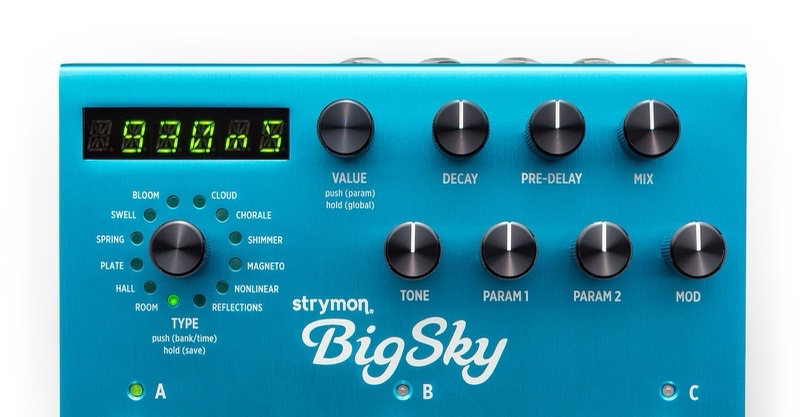
Twelve reverb algorithms — Hall, Plate, Spring, Swell, Bloom, Shimmer, Cloud, Chorale, Magneto, Nonlinear, Reflections, and Room — running on the same SHARC DSP that Strymon uses for its boutique line. BigSky is the modern standard for high-end pedalboard reverb: every algorithm is convincing, the stereo image is wide and stable, and the preset system stores 300 slots accessible via MIDI. The Shimmer and Bloom algorithms in particular shaped the sound of mid-2010s indie and ambient guitar — pour a clean chord into Shimmer with the mod knob at 9 o'clock and you're in Bon Iver territory. Twelve years in, the BigSky is still the reverb every other reverb is benchmarked against.
- 01Shimmer is the canonical octave-up reverb
- 02Bloom is a swelled, almost endless wash
- 03Plate algorithm holds up against real plate emulations
- 04Magneto adds tape echo into the reverb tail
- 05stereo image is wide without sounding fake
03—Power
What it takes to run the BigSky.
300mA at 9V
At 300mA it needs a high-current jack, and an isolated one: big digital pedals put noise on a shared ground.
Typical published draw. Check the label on your unit for its voltage and polarity before you plug in.
- Harley Benton PowerPlant ISO-2 Pro →jacks 3-8 · 300mA
- MXR ISO-Brick M238 →jacks 3-4 · 300mA
- Truetone 1 SPOT Pro CS6 →jacks 1-2 · 500mA
04—In the room
Where else this pedal lives.
Meris MercuryX if you want the next generation; BigSky if you want the proven one.