
01—Pedal catalog
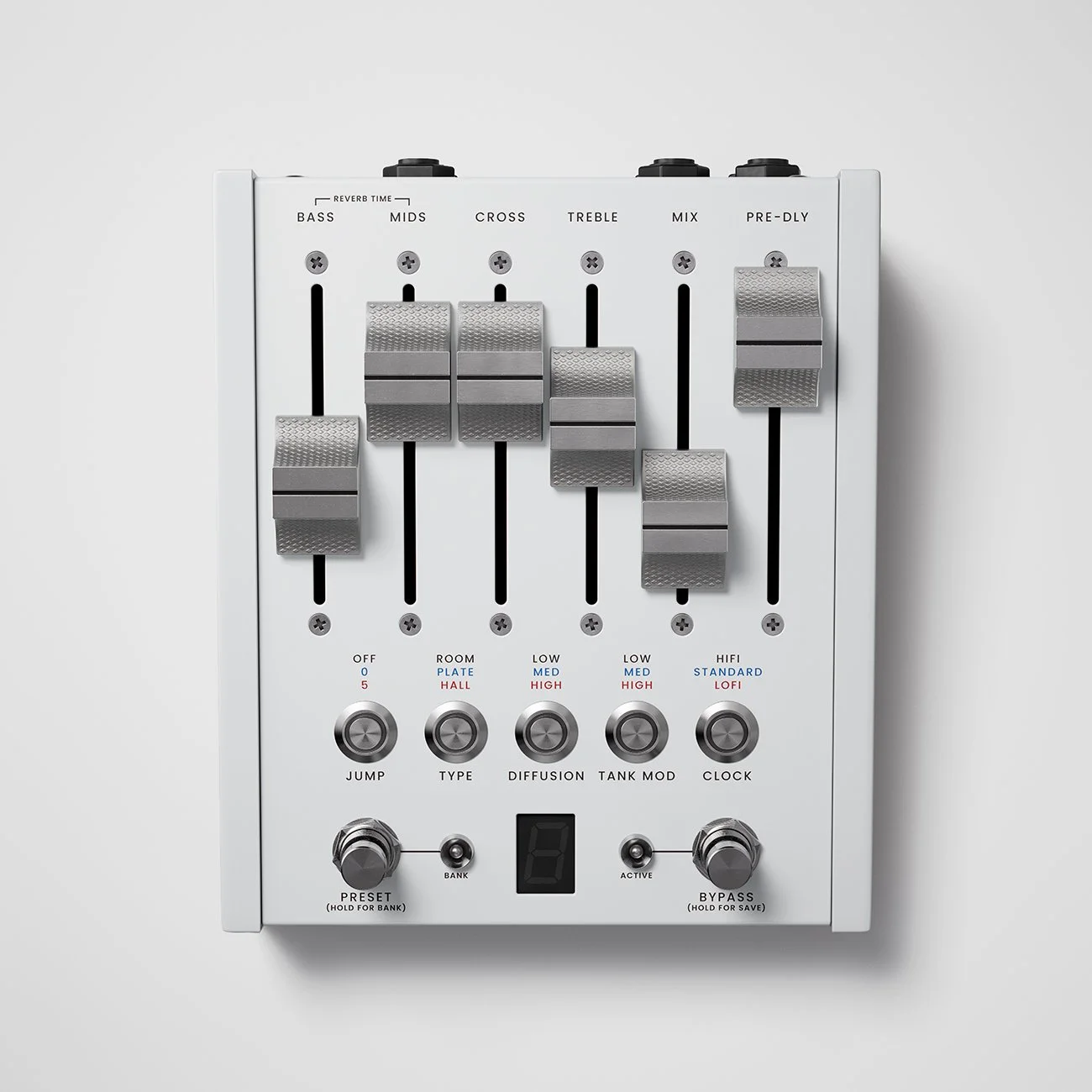
Chase Bliss Audio CXM 1978
Recreating the Lexicon 224, the late-'70s studio rack reverb, in a stompbox.
The most accurate Lexicon 224 you can buy without paying ten grand for the rack unit. If you make records, this earns its space.
02—On the bench
A digital reverb modeled on the Lexicon 224 — the rack reverb that defined the sound of the late 1970s and early 1980s. Chase Bliss built CXM 1978 in collaboration with Meris and a former Lexicon engineer to chase that exact 16-bit, plate-and-hall-and-chamber lushness that no other digital reverb has quite matched. Four modes (hall, plate, room, chamber) plus a 'modulation' control that adds the slow chorusing that gave the 224 its three-dimensional bloom. Stereo in and out. The 'tank' is huge — decay times stretch into the tens of seconds, and the algorithm holds together at every length.
- 01the actual 224 hall, not a 'lexicon-style' approximation
- 02modulation knob is what makes it sing
- 03stereo image is wider than the box should allow
- 04holds together at 30-second decays
- 05plate mode is dryer and percussive
03—Power
What it takes to run the CXM 1978.
500mA at 9V
At 500mA it needs a high-current jack, and an isolated one: big digital pedals put noise on a shared ground.
Typical published draw. Check the label on your unit for its voltage and polarity before you plug in.
- Truetone 1 SPOT Pro CS6 →jacks 1-2 · 500mA
- Truetone 1 SPOT Pro CS7 →jacks 6-7 · 500mA
- Harley Benton PowerPlant ISO-2 Pro →jacks A-B · 500mA
04—In the room
Where else this pedal lives.
Strymon BigSky covers more reverb territory for less, but won't get you the 224 specifically.