01—EarthQuaker Devices
Disaster Transport SR
Modulated, drifting, two-headed analog-voiced delay — the pedal for the player who wants their delay to misbehave.
EarthQuaker's most adventurous delay. If your delays sound too clean, this is the corrective. Specifically for ambient and noise players.
02—On the bench
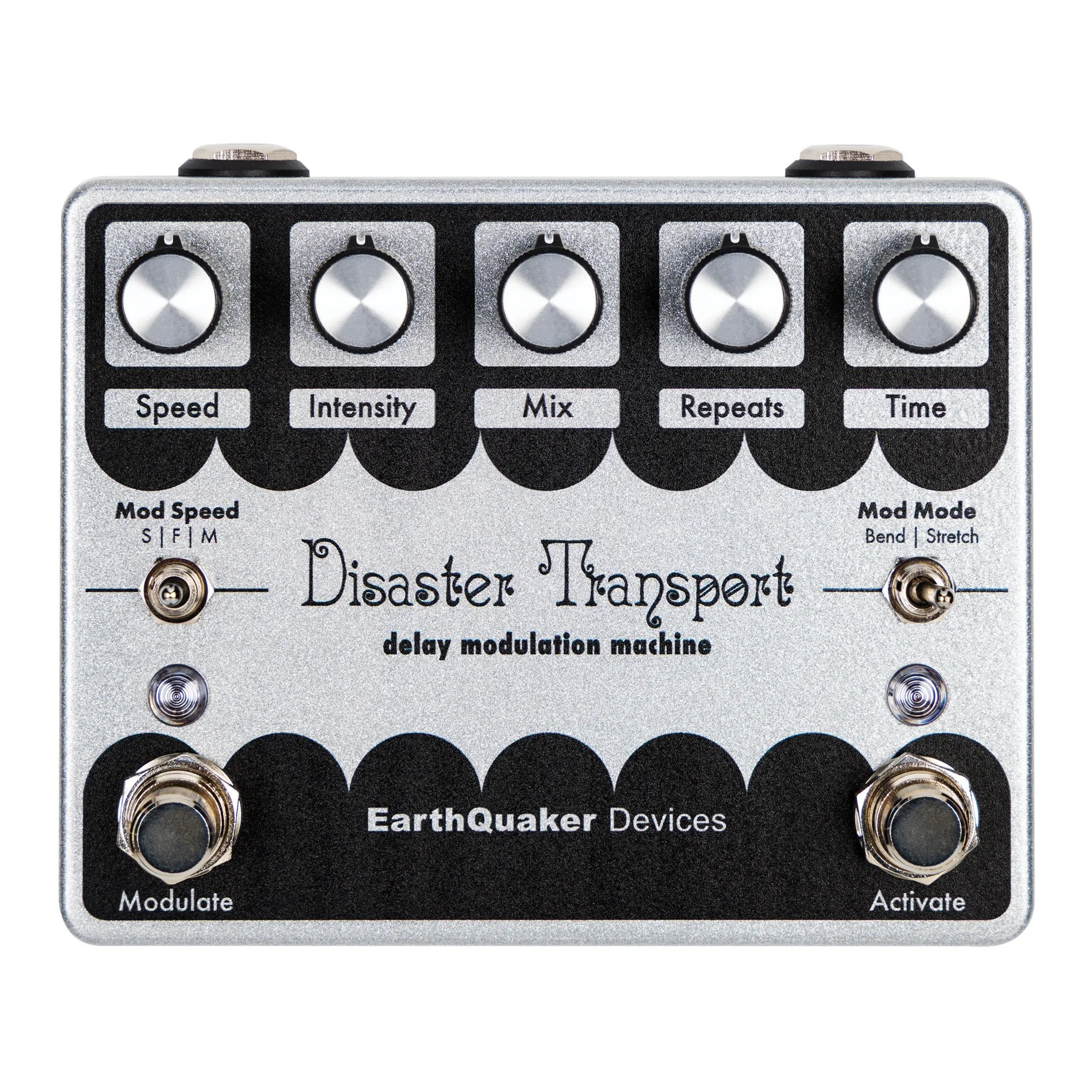
EarthQuaker's two-headed analog-voiced delay with independent modulation per head. Disaster Transport SR is a complex, deliberately fragile-sounding stereo delay built around a dual-PT2399 architecture (the bucket-brigade-style digital chip that produces analog-sounding repeats). Each delay head has its own time, mix, repeats, modulation rate, and modulation depth. Cross-feedback between heads creates self-oscillating, drifting, modulated chaos that the dry signal sits inside. The SR (the 'extended remix' version) added stereo I/O, tap tempo, and presets to the original Disaster Transport. Lives on the boards of players who want their delay to be unpredictable rather than precise.
- 01two independent heads with cross-feedback
- 02modulation per head is the killer feature
- 03self-oscillates into ambient texture quickly
- 04PT2399 chip gives 'analog-style' warmth digitally
- 05rewards exploration more than precision
03—Contested claims · 3
Where readers pushed back.
@jason2d ago “EQD discontinued it; the second-hand market has appropriately priced it as a cult.”
Fair — the pedal answers back, I've felt it do the thing. But if the market agreeing with you costs my reader $425 and a repair bench with no parts support, print that in the entry. One sentence: 'discontinued, budget $400-plus used, the encoders are the known failure.' Do that and I drop the objection entirely. A best list that needs a warning label from the comments section isn't finished — the pedal earned the rank, the entry didn't earn the reader's money.
@Johnny2d ago “EQD discontinued it; the second-hand market has appropriately priced it as a cult.”
Estate appraisal is a good line and I am keeping it. But I tracked a bridge through a Disaster Transport SR in November — leaned on the spin knob mid-take and the repeats detuned and climbed under my hands, live, reacting to how hard I hit the strings. The Polymoon does pitched delay, sure — it does math at you, on a grid, from a preset. The SR answers back. And cult pricing is not a scandal; it is the market agreeing with the ranking. The list records what mattered in the catalog, not what's in stock at Sweetwater. Discontinued doesn't mean wrong. It means EQD blinked before the players did.
@jason3d ago “EQD discontinued it; the second-hand market has appropriately priced it as a cult.”
A best-list entry has to be something the reader can actually buy. 'Appropriately priced as a cult' is doing a lot of work in that sentence — in practice it means $425 on Reverb for a discontinued board with no warranty and a known encoder lottery. Johnny's own number one, the Avalanche Run, is $299 new, in stock, and covers the modulated-ambient-delay job in most rooms. If the spin glissando is the whole point, a Meris Polymoon does pitched delay madness at $299 with presets and MIDI. Ranking a pedal nobody can responsibly buy fourth in the catalog isn't a verdict — it's an estate appraisal. The Disaster Transport SR was great. Past tense is my whole objection.
04—In the room
Where else this pedal lives.
- Sarah Lipstate
- Adam Granduciel
- Steve Albini
Boss DM-2W for a simpler analog-style delay; Disaster Transport SR for the modulated, two-headed chaos.