
01—Pedal catalog
Strymon NightSky
Generative ambient reverb: one hall core turned into an instrument by pitch, glide, and a sequencer.
Strymon's most adventurous reverb. If BigSky was too tame, this is the answer. Sequencer is the killer feature.
02—On the bench
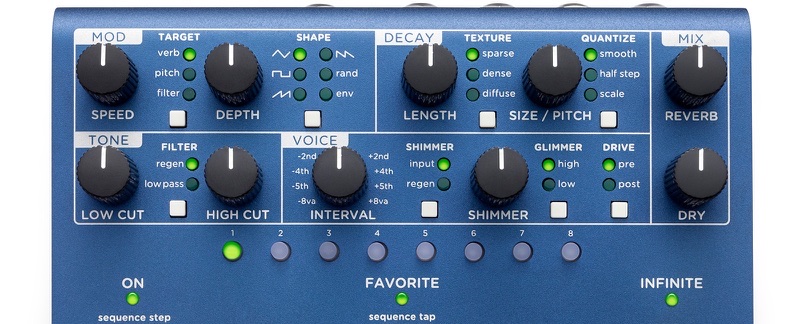
A 'time-warped reverberator' — Strymon's experimental, modulated, pitch-shifting reverb pedal designed for ambient and post-rock players who found the BigSky too well-behaved. NightSky has a single hall-reverb algorithm at its core, but the entire architecture around it (pitch shifting, gliding, sequenced modulation, intensity envelopes) turns that reverb into a generative instrument. Stereo I/O, MIDI sync, CV ins/outs for modular integration, and an internal sequencer that can advance pitch intervals in time with the music. The pedal that took Strymon's algorithmic dryness and added a soul. Less canonical than BigSky, more unhinged. Built for the people who use a Make Noise Mimeophon next to their pedalboard.
- 01the pitch shifting is part of the reverb tail, not a separate effect
- 02internal sequencer turns reverb into a melodic instrument
- 03CV ins make it modular-compatible
- 04intensity envelope adds dynamic shape to swells
- 05freezes hold forever without artifacting
03—Power
What it takes to run the NightSky.
300mA at 9V
At 300mA it needs a high-current jack, and an isolated one: big digital pedals put noise on a shared ground.
Typical published draw. Check the label on your unit for its voltage and polarity before you plug in.
- Harley Benton PowerPlant ISO-2 Pro →jacks 3-8 · 300mA
- MXR ISO-Brick M238 →jacks 3-4 · 300mA
- Truetone 1 SPOT Pro CS6 →jacks 1-2 · 500mA
04—In the room
Where else this pedal lives.
Chase Bliss CXM 1978 for naturalistic reverb; NightSky for the experimental side of the same coin.